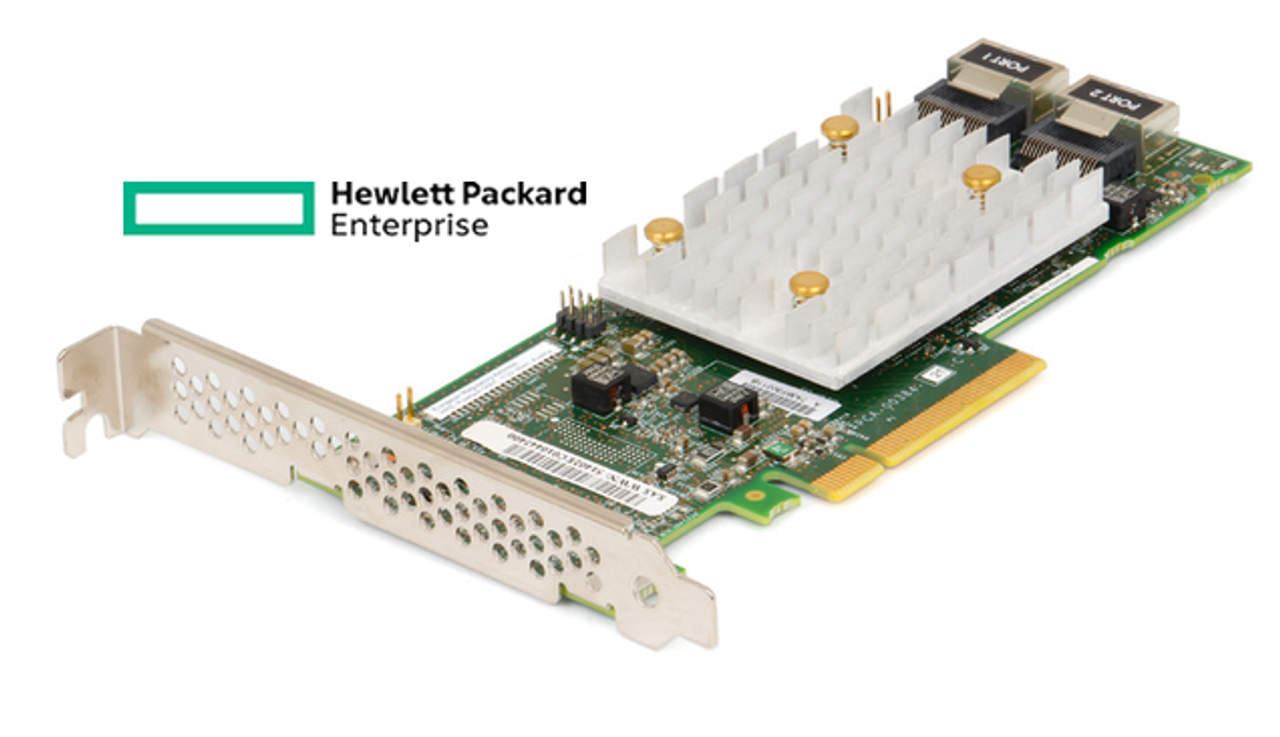
HPE ProLiant ML110 Gen10 Storage Controllers
Genuine HPE Smart Array controllers for the HPE ProLiant ML110 Gen10, new and refurbished. Storage starts on the embedded Smart Array S100i SR Gen10 software RAID, and that controller is SATA only and switched off until somebody enables it — so a single SAS drive in this tower is what turns a plug-in card from an upgrade into a requirement.
ML110 Gen10 Storage Controller Specifications
- Embedded controller: HPE Smart Array S100i SR Gen10 software RAID, supporting 6Gb/s SATA with RAID 0, 1, 5 and 10 on drives attached to the embedded ports
- S100i limits: ten SATA ports, two used by the M.2 option; UEFI mode only; off by default until enabled in the system utilities
- Essential RAID cards: Smart Array E208i-p (eight internal lanes) and E208e-p (eight external), both 12G SAS PCIe plug-in cards with no cache
- Performance RAID cards: Smart Array P408i-p (eight internal lanes, 2GB cache) and P408e-p (eight external, 4GB cache)
- Cache backup: the performance cards require an HPE Smart Storage Battery, sold separately, plus a battery holder kit
- Operating systems: S100i software RAID supports Windows; Linux and VMware run the embedded SATA ports in AHCI mode instead
The embedded controller is SATA only. The Smart Array S100i SR Gen10 is software RAID over the embedded SATA ports, it runs in UEFI mode only, and it is switched off until somebody enables it. A single SAS drive is what makes a plug-in card compulsory, and a P408i-p or P408e-p also needs a Smart Storage Battery and a holder kit, neither of which comes in the box.
Do You Need a Plug-in Smart Array Card?
| Controller | Lanes and cache | What it suits |
|---|---|---|
| S100i SR Gen10 (embedded) | 10 SATA ports, no cache | SATA drives on the embedded ports, Windows, UEFI boot |
| E208i-p SR Gen10 | 8 internal lanes, no cache | SAS drives in the chassis, uncached |
| E208e-p SR Gen10 | 8 external lanes, no cache | An external SAS enclosure |
| P408i-p SR Gen10 | 8 internal lanes, 2GB cache | Cached RAID on the internal cage |
| P408e-p SR Gen10 | 8 external lanes, 4GB cache | Cached RAID on external storage |
Two questions settle this page. The first is SAS or SATA: the S100i handles SATA on the embedded ports and nothing else, so the drives already fitted decide whether a card is needed. The second is internal or external, which is what the i and the e in the part name mean — an E208e-p or a P408e-p drives an enclosure outside the chassis and will not serve the cage inside it.
Choosing the Right ML110 Gen10 Storage Controller
- SAS drives need a card; SATA drives may not. The embedded S100i is a SATA controller, so on an all-SATA machine a plug-in card buys cache and hardware RAID rather than basic function.
- Budget a slot and a battery for the performance cards. The P408i-p and P408e-p take one of the five PCIe 3.0 slots and require a Smart Storage Battery and its holder kit, neither of which arrives with the card.
- The i and e suffixes are not interchangeable. An internal card will not drive an external enclosure, and an external card will not drive the internal cage.
- Check the operating system before relying on S100i RAID. HPE supports it on Windows; for Linux it points to an in-distribution software RAID 1 boot volume instead.
- Legacy boot needs a card. The S100i operates in UEFI mode only, so a server that has to boot in legacy mode needs an additional controller.
Complete Your ML110 Gen10 Build
Controllers and drives are bought together — see ML110 Gen10 drives for what the array will hold. Also available: ML110 Gen10 memory, networking adapters, power supplies and rack options, or the full ML110 Gen10 parts listing. Background reading: what HPE Smart Array controllers do.
ML110 Gen10 Storage Controllers FAQ
Does the ML110 Gen10 have a RAID controller built in?
Yes, the Smart Array S100i SR Gen10 software RAID. It supports RAID 0, 1, 5 and 10 on SATA drives attached to the embedded ports, runs in UEFI mode only, and is off by default.
Can the S100i run SAS drives?
No. The S100i is a 6Gb/s SATA controller. SAS drives in this tower need a plug-in Smart Array card such as the E208i-p or the P408i-p.
What is the difference between the E208 and P408 cards?
Cache. The E208i-p and E208e-p are Essential cards with no cache; the P408i-p carries 2GB and the P408e-p 4GB, and those cached cards are the ones that require the Smart Storage Battery.
Do I need a Smart Storage Battery?
With a performance RAID controller, yes. HPE lists the Smart Storage Battery as required for the P408 cards and sells it separately, and a battery holder kit is called for alongside it.
Does S100i software RAID work with Linux or VMware?
Not as RAID. HPE supports S100i software RAID on Windows. Linux and VMware use the embedded SATA ports in AHCI mode, and for Linux HPE publishes an in-distribution route to a two-disk RAID 1 boot volume.
How many PCIe slots does a storage controller use?
One. The server has five PCIe 3.0 slots, and every Smart Array option documented for it is a plug-in card rather than a modular one.
✅ Looking for a specific ML110 Gen10 storage controller? Browse our full selection below.
Browse all models

Why Global One?
- Trusted by thousands. Over 36,000 customers in 100+ countries trust Global One Technology to deliver mission-critical HP Enterprise hardware - including Fortune 500 businesses, schools, hospitals, and federal, state, and local goverment agencies.
- HPE is our specialty! We only sell genuine HP Enterprise parts.
- EASY ordering process. Purchase online now with credit card or PayPal!
- FAST shipping. Global One Technology ships orders received by 4pm ET the same day and offers NEXT DAY delivery to US customers.